
WOTA Initiates Preparations for the Establishment of the “Water Infrastructure Best Mix Promotion Council (Provisional Name)”
— Realizing Optimal Combinations of Centralized and Decentralized Infrastructure in Local Communities: Calling for Broad Participation from Local Governments and Water Infrastructure Enterprises, Including Johkasou DX Initiatives —
WOTA Corp. (Headquarters: Chuo-ku, Tokyo; Representative Director and CEO: Yosuke Maeda; hereinafter “WOTA”) has initiated preparations for the establishment of the “Water Infrastructure Best Mix Promotion Council (Provisional Name)” (hereinafter “the Council”). This initiative aims to realize sustainable regional water infrastructure tailored to local needs, addressing challenges such as population decline, aging facilities and pipelines, financial and human resource constraints, and disaster risks.
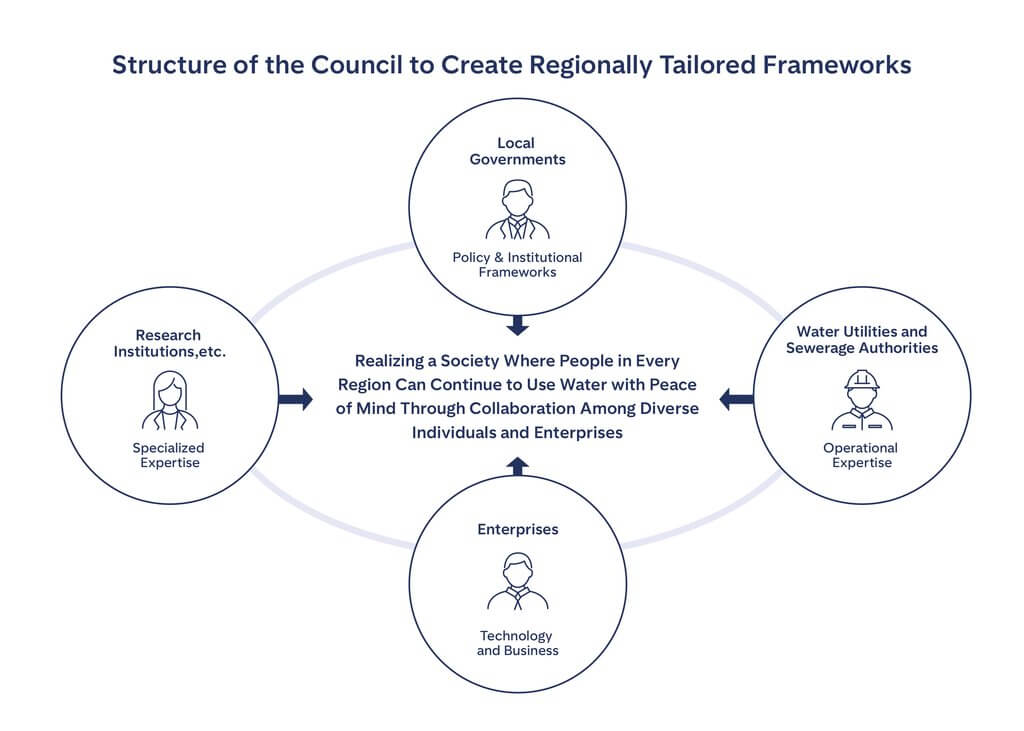
The Council aims to put into practice an optimal mix of approaches suited to local conditions: maintaining, renewing, and reorganizing existing water and sewer systems; upgrading existing decentralized infrastructure, including johkasou systems (on-site domestic wastewater treatment systems); and introducing new options such as small-scale decentralized water-recycling systems. The platform is envisioned as a collaborative space where local governments, companies across broad sectors—including water-related industries, construction and housing, digital technology, energy, and finance/insurance—and research institutions work together across technological, institutional, and operational boundaries.
In the establishment preparations, key themes under consideration include the reorganization of regional water infrastructure, next-generation decentralized water infrastructure, digital transformation of johkasou systems (Johkasou DX), regional implementation and operational structures, as well as institutional design, finance, and standardization. Moving forward, through exchanges of views with local governments, corporations, and research institutions, WOTA will develop the operational structure and activity scope, including subcommittees, with the aim of formally establishing the Council by the end of 2026.
〈Background of Establishment Preparations〉
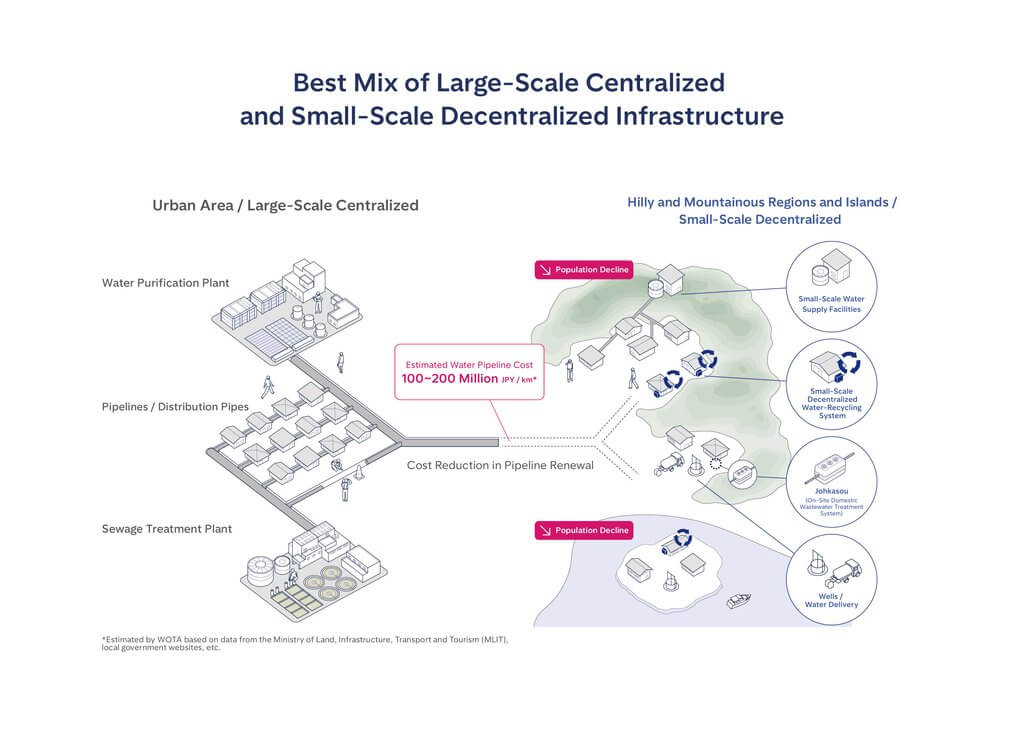
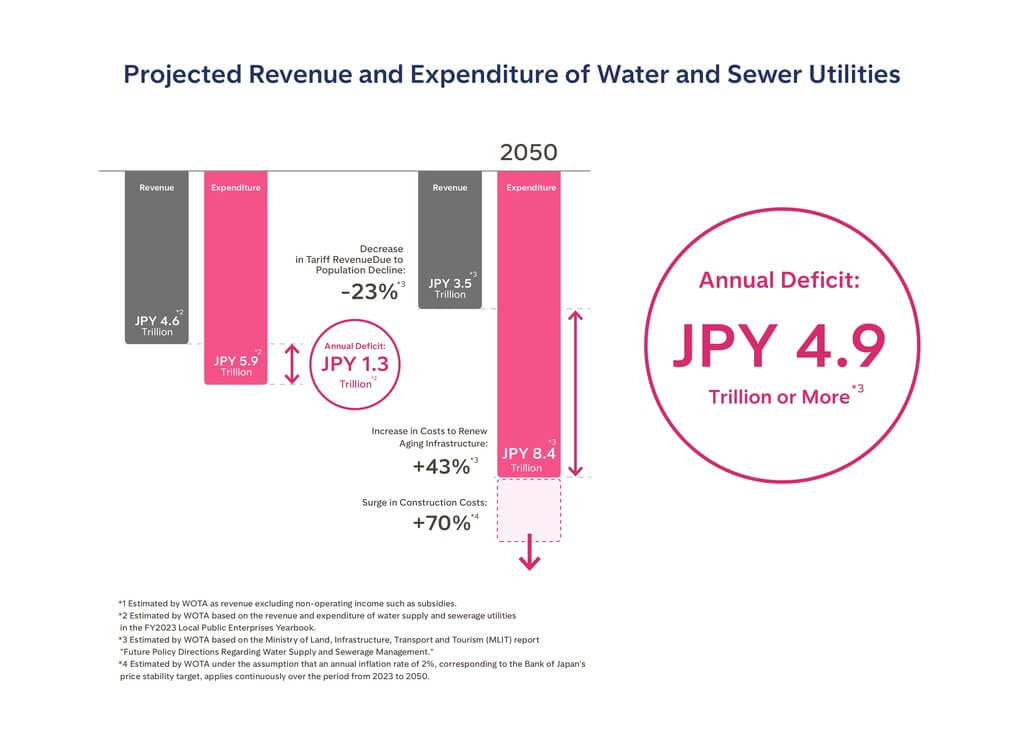
Water supply and sewerage systems in Japan have long supported daily life and industrial activities, contributing significantly to public health improvements. However, declining tariff revenues due to population decline, the aging of facilities and pipelines, and rising replacement costs are making it increasingly difficult in some regions to continue maintaining and renewing existing facilities without changing their configuration.
In response to these circumstances, the Ministry of Land, Infrastructure, Transport and Tourism (MLIT) presented policy directions in its “Second Report of the Committee on the Future Course of Water Supply and Sewerage Policy” published in January 2026, emphasizing “integrated business operations across multiple local governments” and “optimal placement of facilities featuring the best mix of centralized and decentralized systems.” Furthermore, MLIT released the “Guidelines for the Introduction of Decentralized Systems in Water Supply Businesses” in March 2026, advancing the framework for concrete evaluations by water utility operators.
Meanwhile, population distribution, topography, water sources, and the status of existing facilities vary by region. Translating the best mix concept into concrete plans and projects requires comparing multiple options with a view toward post-implementation operation and maintenance.
To connect such best-mix evaluations to continuous regional implementation, a cross-cutting platform is required—one that addresses municipal operations, institutional frameworks, procurement, operation and maintenance, and financing alongside individual technology and product development. WOTA is calling for the establishment of the Council as a forum where diverse stakeholders develop solutions together, starting with local challenges and without presupposing the selection of any particular company or technology.
〈Objectives of the Council〉
Rather than making a uniform choice between centralized or decentralized models, the Council aims to leverage the strengths of each, defining appropriate water infrastructure configurations and operational models tailored to each region.
Maintaining, renewing, and upgrading existing water supply and sewerage systems; proceeding with facility consolidation and scale optimization; advancing existing facilities such as Johkasou; and introducing new decentralized systems will all be compared and evaluated under a unified framework. On the premise of ensuring water quality, safety, and required service levels, the Council emphasizes enabling regions themselves to select sustainable water infrastructure models without adhering to fixed methods, considering total costs from construction to maintenance and renewal, required personnel, disaster resilience, and environmental impact.
Local governments, as the entities possessing the deepest knowledge of local challenges, are expected to proactively participate in setting issues, evaluating methodologies, identifying institutional hurdles, and building implementation models. Additionally, long-standing water infrastructure operators, technology innovators, and cross-industry enterprises will collaborate to construct operational structures capable of sustained local execution.
Activities will extend beyond information exchange to problem definition, comparative evaluation, joint demonstrations, implementation model building, policy and institutional proposals, and standardization discussions. By accumulating and sharing these outcomes for adaptation in other regions, the Council aims to realize a society capable of sustainably utilizing water essential for daily living during both normal times and emergencies.
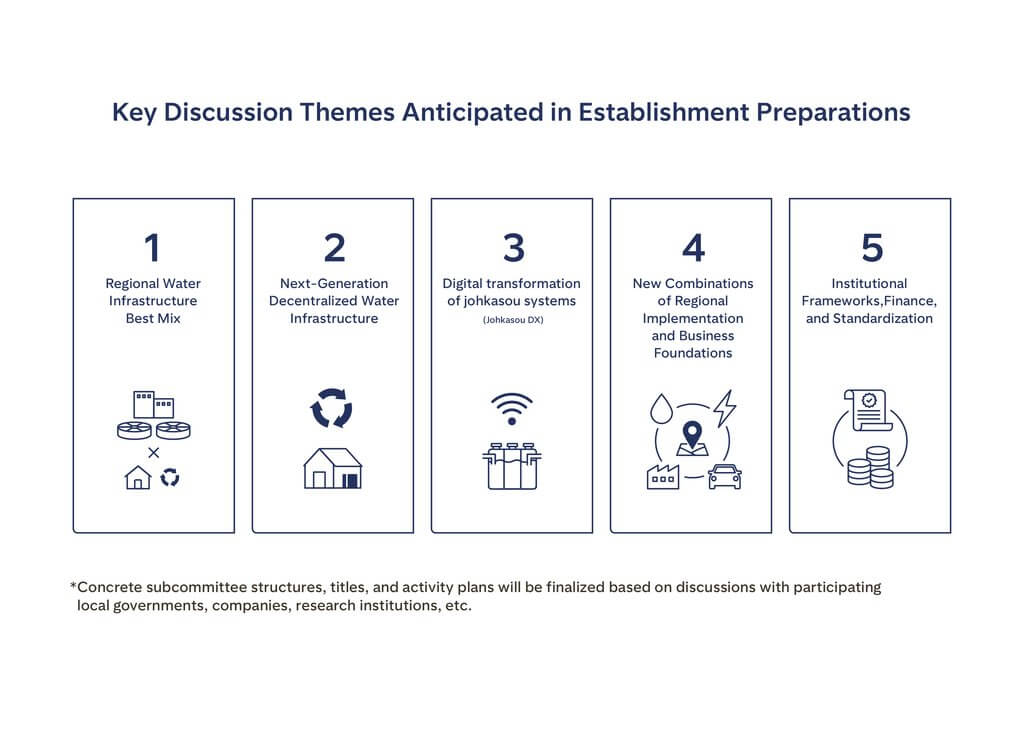
〈Key Discussion Themes Anticipated in Establishment Preparations〉
The following themes are currently conceptualized as primary focus areas. Concrete subcommittee structures, titles, and activity plans will be finalized based on discussions with participating local governments, companies, and research institutions.
1.Regional Water Infrastructure Best Mix
Evaluating future configurations of water infrastructure combining centralized and decentralized systems based on regional demographics, geographical conditions, existing facilities, water sources, and financial statuses. It will develop methods for comparing options such as maintaining and renewing existing facilities, cooperation across jurisdictions, facility consolidation and closure, capacity adjustments, and decentralization. It will also develop models to support local government planning and consensus-building.
2.Next-Generation Decentralized Water Infrastructure
Examining application conditions for diverse options, including small-scale decentralized water-recycling systems; new water source and supply technologies such as atmospheric water generation (AWG); community- and facility-level wastewater treatment; and the use of recycled water and rainwater. Necessary conditions for connection with existing infrastructure and continuous local operation—including water quality, safety, performance evaluation, maintenance structures, and emergency utilization—will be defined.
3.Johkasou DX
Positioning Johkasou as critical assets within regional water infrastructure and exploring their advancement through sensing, remote monitoring, operational control, and digitization of maintenance records.
Specifically, it will examine the technologies, data, institutional frameworks, and business arrangements needed to improve treatment performance and operation and maintenance through sensing, remote monitoring, operational control, and the digitization of operation and maintenance information. Leveraging the expertise of existing maintenance operators, inspection agencies, and manufacturers, the initiative aims to reduce field burdens and achieve sustainable operation and maintenance.
4.New Partnerships for Local Deployment and Service Delivery
Exploring possibilities for constructing sustainable regional operational structures by integrating water infrastructure with energy, mobility, and regional industries. Beyond optimizing individual equipment, the focus will be on forming business and supply models for design, construction, operation, and maintenance utilizing local enterprises and existing business foundations.
5.Institutional Frameworks, Finance, and Standardization
Addressing cross-cutting implementation challenges identified across subcommittees, including institutional regulations, procurement, public-private partnerships (PPP), financing, insurance, performance evaluation, and data interoperability. By connecting with Water PPPs, developing business models with regional financial institutions, and standardizing evaluation metrics and data specifications, it will seek to incorporate findings from deployment into institutional frameworks and industry standards.
〈Process Toward Establishment〉
As the convening entity, WOTA will proceed with exchanges of views with local governments, water supply utilities, sewerage managers, enterprises, and research institutions. Moving forward, discussions with relevant government ministries will also be conducted to establish a framework connecting field challenges with policy and institutional evaluations.
During the preparation phase, the founding principles, management structure, membership categories, and activity plans for each subcommittee will be finalized. Operational rules addressing fair competition, trade secret and personal information protection, and conflict of interest management will be established to create an open organization capable of collaborating with related initiatives.
Targeting official establishment within 2026, participating entities, administrative structures, and concrete action plans will be formally announced once finalized. Following establishment, initial activities are expected to include examining potential model regions and demonstration topics based on local government challenges, and identifying common evaluation metrics and institutional issues.
〈Participation and Consultations for Establishment Preparations〉
WOTA invites local governments, enterprises, and research institutions interested in this concept to engage in consultations regarding establishment preparations and participation.
We welcome involvement from a broad spectrum of sectors, including water supply/sewerage, Johkasou, water treatment, construction/housing/facilities, sensors/AI/telecommunications, energy, and finance/insurance. Regardless of current product or service adoption statuses, we look forward to hearing from all entities interested in co-creating the future vision of regional water infrastructure.
※ At this stage, consultations are open for exchanges of views and prospective participation in establishment preparations. Formal membership enrollment terms will be announced as the operational structure is finalized.
For inquiries regarding this matter, please contact us here
〈Comment from Yosuke Maeda, Representative Director and CEO of WOTA Corp.〉
“What future water infrastructure demands is not a binary choice between centralized and decentralized systems, but the creation of mechanisms tailored to local communities by leveraging the strengths of both. What we must preserve is not specific equipment or methodologies, but daily life itself—where people in every region can continue to use water with peace of mind.
Achieving this requires connecting not only technology, but also institutional frameworks, operation and maintenance, financing, and the local individuals and enterprises supporting these systems. This is not a challenge that a single company can resolve alone.
As one stakeholder, WOTA hopes to learn from the expertise of those who have long supported existing water infrastructure, innovators creating new technologies and businesses, and local governments responsible for their communities’ futures. Together, we want to turn discussions into deployment in local communities.
To realize a society where every region in Japan can select sustainable water infrastructure for generations to come, we begin by creating this platform for dialogue.”
【About WOTA Corp.】
WOTA is a private enterprise aiming for structural solutions to global water issues. Since its founding in 2014, WOTA has developed “Decentralized Water Regeneration Systems” and “Autonomous Water Treatment Control Technology” to reuse domestic wastewater to the maximum extent, addressing problems caused by unequal distribution, scarcity, and pollution of global water resources. WOTA has brought two products to market, contributing to emergency water access during disaster outages and improving public hygiene. WOTA has also developed a “Residential Water Regeneration System” for daily water use and begun supplying water in select regions in Japan and abroad.
Details: https://wota.co.jp/en/