
WOTA Corp. Announces Summary Report of MLIT Commissioned Research: ‘Redefining Emergency Water Supply in Large-Scale Disasters’
–Trial calculations based on the 2024 Noto Peninsula Earthquake(※1) show that introducing a water-recycling system(※2) reduces the water needed for bathing and handwashing by over 90%, cutting total emergency water supply(※3) by about 60% overall.−
WOTA Co., Ltd. (Head Office: Chuo City, Tokyo; President & CEO: Yosuke Maeda; hereafter “WOTA”) was commissioned by the National Institute for Land and Infrastructure Management of the Ministry of Land, Infrastructure, Transport and Tourism (MLIT) to conduct the joint research project “Study on Integrated Operation of Emergency Water Purification and Emergency Water Supply in Disasters” (hereafter, “this research”), together with NJS Co., Ltd. and Metawater Co., Ltd. As a joint research body, we quantitatively verified the effectiveness of a new method of emergency water supply during large-scale disasters.
To support national and local government preparedness for emergency water supply in future large-scale disasters, we are releasing a report that organizes the principal findings of the study.
The Challenge of Domestic (Non-drinking) Water Shortages During Disasters
During the 2024 Noto Peninsula Earthquake, long-lasting and wide-area water outages occurred, severely affecting the living environment of evacuees. While drinking water was secured through emergency measures, domestic water—which requires 10 to 100 times the volume of drinking water—was in severe short supply. As a result, the conventional emergency water-supply system centered on water tanker trucks proved unable to maintain sanitary conditions at some shelters. In particular, for bathing and handwashing—together accounting for roughly 60% of domestic water demand—on-site provision is essential, and establishing a supply framework became the bottleneck to ensuring sanitary conditions during the disaster.*
In light of this situation, the government is strengthening efforts to secure domestic water. The Cabinet Office has revised disaster-response policies and, in its guidelines for shelter living environments, explicitly states securing bathing opportunities in line with the Sphere standards (international humanitarian benchmarks). Furthermore, in the First Mid-Term Plan for National Resilience Implementation(※4), a goal has been set for all municipalities to stockpile to meet Sphere standards by 2030.
At the same time, social consensus has yet to form regarding the required quantities of domestic water and how to secure it, and current countermeasures cannot be called sufficient. Therefore, this paper explains the effectiveness verification conducted in this research concerning emergency water supply that leverages water-recycling systems and portable water-purification units.
*Other domestic water demands also present challenges. For toilets, although there are operational issues such as cleanliness and waste removal, the supply of temporary toilets is relatively assured, enabling a certain level of living environment to be restored early on. Cooking and laundry can be substituted by carrying them out outside the outage area, with meals and clothing transported in.
Notes
※1:The 2024 Noto Peninsula Earthquake: The magnitude 7.6 earthquake that struck the Noto Peninsula on January 1, 2024.
※2:Water-recycling system: In disaster contexts, compact or localized systems that purify used water so it can be reused (e.g., for bathing and handwashing), drastically reducing freshwater demand.
※3:Emergency water supply: Short-term water provision measures during disasters before normal service restoration, typically involving tanker trucks, bottled water, temporary distribution points, or mobile treatment units.
※4:First Mid-Term Plan for National Resilience Implementation: A Japanese government plan under the National Resilience initiative setting multi-year targets and actions to strengthen disaster preparedness; here it specifies that municipalities should meet Sphere standard stockpiles by 2030.
Research Overview
・Project Title: Waterworks Innovative Technology Demonstration Project (A-JUMP Project)
・Commissioning Agency: National Institute for Land and Infrastructure Management, Ministry of Land, Infrastructure, Transport and Tourism (MLIT)
・Research Title: Study on the Integrated Operation of Emergency Water Purification and Emergency Water Supply in Disasters
・Research Period: October 2024 – March 2025
・Implementation Structure: Joint research body of NJS Co., Ltd.; Metawater Co., Ltd.; and WOTA Co., Ltd.
Summary of Report Findings
This study verifies the effectiveness of emergency water supply that utilizes water-circulation systems and portable water-purification units. Using Suzu City, Ishikawa Prefecture— which experienced a prolonged, citywide water outage during the Noto Peninsula Earthquake— as a model for trial calculations, we confirmed quantitative effects in meeting the significant shortfall of domestic (non-drinking) water that occurs during outages.
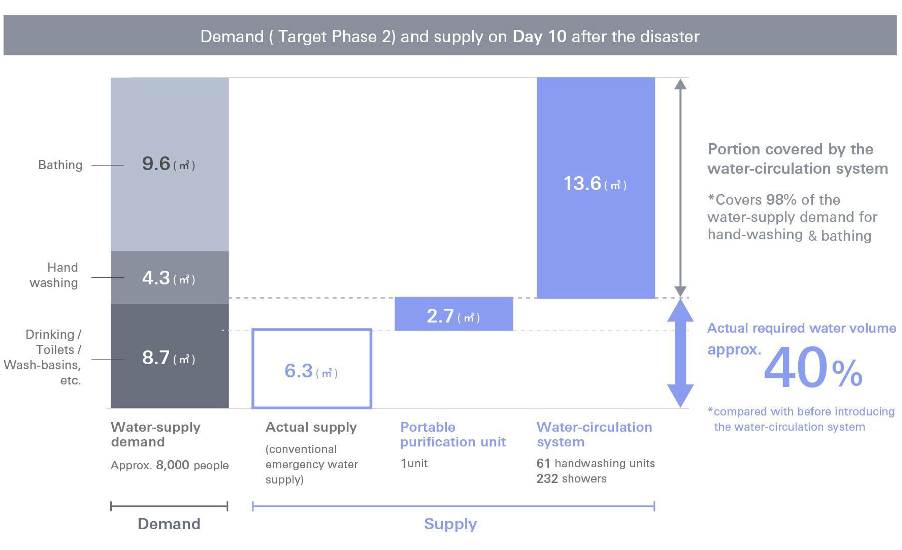
In the Suzu City trial calculations for this study, when portable water-purification units and water-circulation systems for handwashing and bathing were sufficiently deployed *, the actual volume of water required to meet supply demand for maintaining sanitary conditions could be reduced to about 40% of the pre-introduction level. This indicates the possibility of satisfying evacuees’ water-supply needs and maintaining sanitary conditions even under outage conditions. In particular, for bathing and handwashing—uses that account for roughly 60% of domestic water demand and require 10 to 100 times the volume of drinking water—the required water volume could be cut by over 90%, contributing substantially to overall reductions.
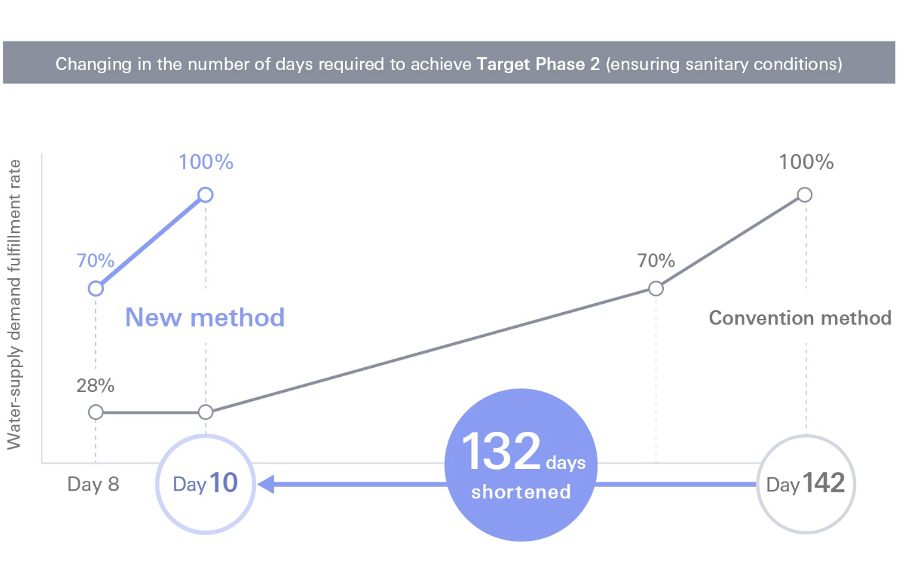
Furthermore, the time needed to satisfy evacuees’ water-supply demand was shortened dramatically: whereas conventional methods required 142 days from the disaster’s onset, the introduction of water-circulation systems reduced this to the 10th day after the disaster, a reduction of 132 days.
*: For efficient distribution, seven portable water-purification units are installed near shelters (with the assumption that one of them has begun operating by Day 10). Water-circulation systems are installed at all shelters—excluding temporary facilities operating for one week or less—at quantities meeting Sphere standards relative to the number of evacuees immediately after the disaster by town (total 11,000 people): handwashing—61 units calculated at one per 250 people; showers—232 units calculated at one per 50 people.
<Figure 1: Water-Supply Demand and Supply Volume for Maintaining Sanitary Conditions (as of Day 10 after the disaster)>
<Figure 2: Transition of the Fulfillment Rate of Water-Supply Demand for Maintaining Sanitary Conditions>
Going forward, it will be necessary to visualize evacuees’ water-supply demand in light of outage risks and to build social consensus around practical emergency water-supply methods. On that basis, it is important to determine, on a nationwide scale, the quantities of domestic-water equipment and materials needed—including water-circulation systems—pre-position shortfalls in advance, and standardize operations to ensure effectiveness.
WOTA will continue to work with the government, municipalities, and companies to promote advance preparations for supplying domestic water and ensuring sanitary conditions during disasters. Building on this case study, we will continue to investigate, analyze, and communicate about the common issue of domestic-water shortages during disasters and corresponding responses, and—through the standardization of domestic-water assurance during disasters and the development of nationwide systems—help drive the spread of measures to alleviate water stress in disasters.
[About WOTA Corp.]
WOTA is a private company aiming to provide structural solutions to water-related problems.
Since our founding in 2014, to address issues arising from the uneven distribution, depletion, and pollution of the planet’s water resources, we have been developing “decentralized water-circulation systems,” which regenerate and make maximal use of domestic wastewater, and the “autonomous water-treatment control technologies” that enable them. We have already launched two products, contributing to emergency water use during water outages in disasters and to improvements in public health. We have also developed a “household water-circulation system” that enables everyday water use, and have begun supplying water in certain regions both in Japan and overseas.
Details here: https://wota.co.jp