masterplan 1.0
2022.9.18
One of humanity’s most pressing issues is the supply of fresh water, and WOTA exists to provide solutions to this problem. But what exactly does that involve? Let us explain.
Our purpose
Whenever we use water, we inevitably produce wastewater. Wastewater not only wastes valuable water, but can also contaminate existing freshwater sources and render them unusable. If we could convert wastewater into reusable water, we could address a wide range of water-related challenges—such as water shortages and environmental pollution. WOTA’s goal is to complement conventional large-scale, centralized infrastructure (water supply and sewerage systems) with a “small-scale decentralized water regeneration system” that enables circular water reuse, thereby supporting the transition to a sustainable society.
From large-scale, centralized lifelines to small-scale, decentralized lifelines
In the 20th century, essential utilities (lifelines) were built and operated as large-scale, centralized infrastructure; in the 21st century, they have been shifting toward small-scale, decentralized infrastructure. As these lifelines have become smaller and more personal, innovation has advanced: communications now fit in our pockets via mobile phones, and energy no longer relies solely on massive power plants—households can install batteries and solar systems and become more self-sufficient.
Large-scale, centralized infrastructure is typically developed at the city level (sometimes for populations of several million) and requires decades to build, with investment recovery spread over that same long timeframe. By contrast, small-scale, decentralized infrastructure can be deployed for a single person, completed in as little as one day, and depreciated over just a few years—much like a household appliance. By partially replacing large-scale, centralized infrastructure in low-density or rapidly depopulating areas with small-scale, decentralized alternatives, society as a whole should be able to achieve a fiscally sustainable “best mix.” From another perspective, this also represents a partial shift from a civil-engineering/construction model—where each facility has its own individual lifecycle—to a manufacturing-style system with standardized lifecycles, which should improve the efficiency of the industry itself over the long term.
Realizing a small-scale, decentralized circular water society
To realize a small-scale, decentralized circular water society, compact, high-efficiency water regeneration systems are indispensable. WOTA’s first product, the WOTA BOX, is a portable water regeneration system that can regenerate and recirculate more than 98% of household wastewater. It can deliver what city-scale water networks do—using a device with a volume of just 0.25 m³. Its water recovery rate far exceeds the 60–80% typically achieved on space stations.
With the WOTA BOX, households can regenerate wastewater on-site, at the point of use, and reuse it in a closed loop— making continued water use possible even where there is no piped water supply. By boosting humanity’s water-use efficiency by 50× or more, it can fundamentally address water scarcity; and by minimizing wastewater and keeping it fully controlled, it can minimize the risk of environmental contamination.
Autonomous control technology for water treatment
WOTA’s core technology is autonomous control of water treatment. Traditionally, operating water treatment facilities relied on analog, experience-based know-how—much like the craftsmanship of a sake brewery “toji.” To enable advanced management of water treatment systems hundreds of thousands of times smaller than conventional facilities, WOTA has focused on improving the precision of unmanned, autonomous control through its proprietary sensor and AI technologies.
Until now, water-treatment R&D has largely focused on improving components such as membranes, chemicals, and microorganisms. We instead have driven innovation through measurement science and computer science. In a sense, this is the foundational software—an operating system (OS)—for water treatment. In fact, there is a possibility that water treatment facilities around the world could, in the future, be autonomously controlled using WOTA’s water-treatment OS.
The key point is dynamic control of water treatment. Water-treatment systems are complex, with the quality of the input water constantly fluctuating and the condition of treatment components also continually changing. To precisely control output water quality, dynamic control is essential. Just as a self-driving car adjusts flexibly to road geometry and surrounding traffic, WOTA has achieved dynamic, autonomous control of water treatment.
Until now, the bottleneck in water regeneration has been cost. With WOTA’s autonomous control technology, the cost of water regeneration has been reduced to around one-fifteenth of conventional levels.
What challenges lie ahead?
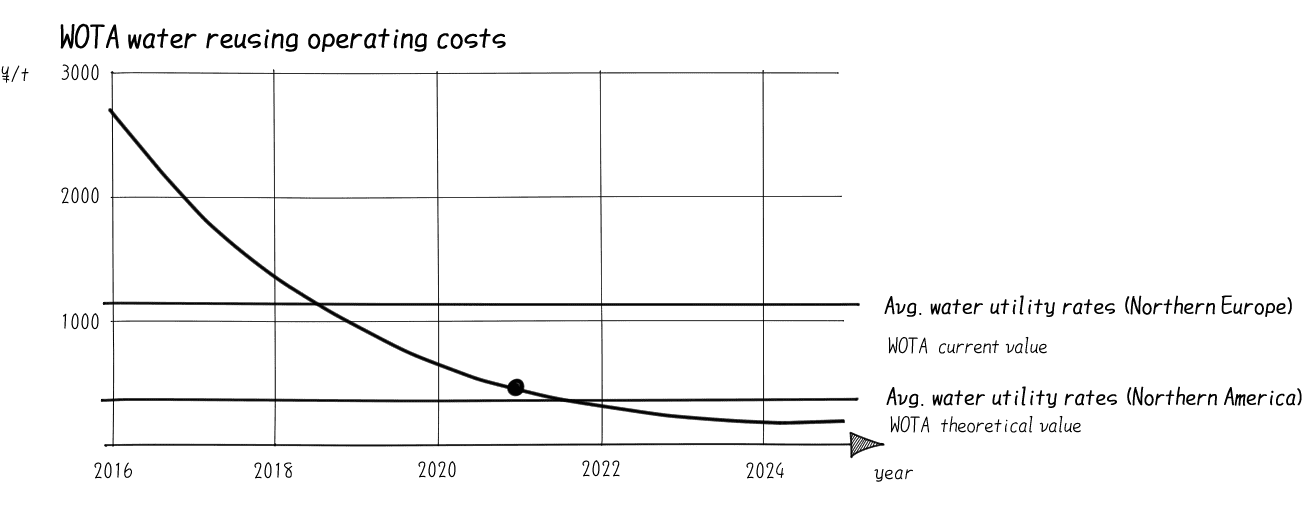
WOTA’s products are meant to be adopted worldwide, but there is one key challenge: bringing our water-regeneration cost below the cost of piped water as quickly as possible.
At present, the cost of WOTA’s water-regeneration treatment is lower than water tariffs in the Nordic countries (10–12 USD/t) but slightly higher than those in North America (4–5 USD/t). Ultimately, by achieving 2.2 USD/t, WOTA’s products will become an economically rational choice virtually anywhere in the world.
The more participants we have, the faster we solve water challenges
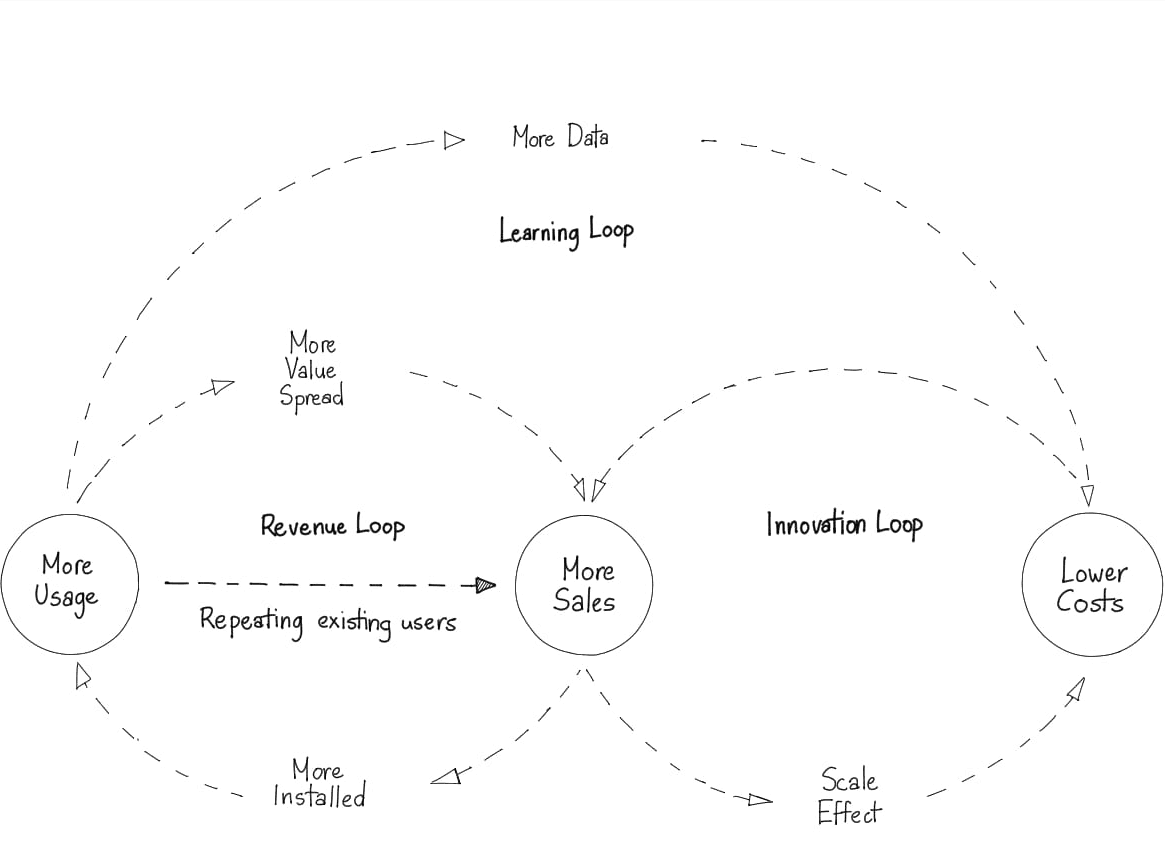
WOTA’s water-regeneration cost falls as participation grows, because “More Sales” and “More Usage” translate directly into “Lower Costs.” As with almost all new technologies, early products carry a higher unit cost until they are fully optimized—and WOTA is no exception. As a fast-growing technology company, we reinvest all free cash flow into R&D in order to reduce costs quickly and bring our next products to market. In other words, those who purchase WOTA products are, in effect, helping finance the cost reductions. With “More Sales,” the number of regions where WOTA is more economically rational than conventional water utilities expands, accelerating the transition to a small-scale, decentralized circular water society.
In addition, with “More Usage,” the more data we accumulate, the further WOTA’s autonomous control technology improves. This, too, contributes to “Lower Costs.” As participation grows, our products can be deployed across a wider range of regions, which in turn attracts more participants. Through this virtuous loop, we move rapidly toward realizing the best mix of large-scale centralized infrastructure and small-scale decentralized systems.
The more users we have, the quicker we can solve our water problems
WOTA’s water reusing system is designed so that the cost per user decreases as the user base increases. In other words, more sales and more usage means lower costs.
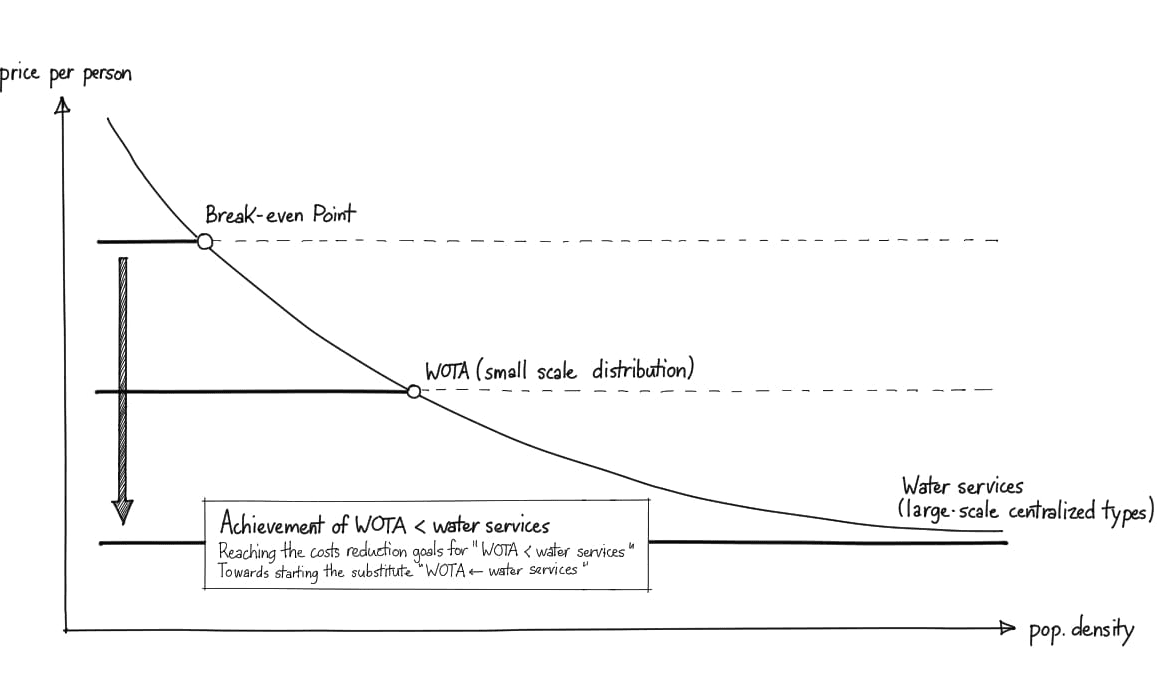
As with all new technology, the unit cost will initially remain high until the production process has been optimized. As a rapidly growing technology company, we want to be able to deliver the next product to the market at as low a cost as possible. That’s why we’ve directed all our free cashflow towards R&D. By purchasing a WOTA product, you’re helping us raise the funds we need to lower the unit cost of our products. With more sales, it will be easier for us to promote WOTA products in more markets as a sensible, money-saving alternative to water infrastructure – which will ultimately help society transition towards using small-scale, decentralized water reuse systems.
With more usage of these initial WOTA products, we’ll be able to gather crucial data that will help us take our autonomous technologies to the next level. Eventually, this will lead to lower costs, both for WOTA and for the consumer. The more users we get, the more markets we can tap into, which will help us gain even more users. By repeating this loop, we can accelerate our transition into a society that gets its water from small-scale, decentralized water reusing systems.
Here’s what our master plan looks like:
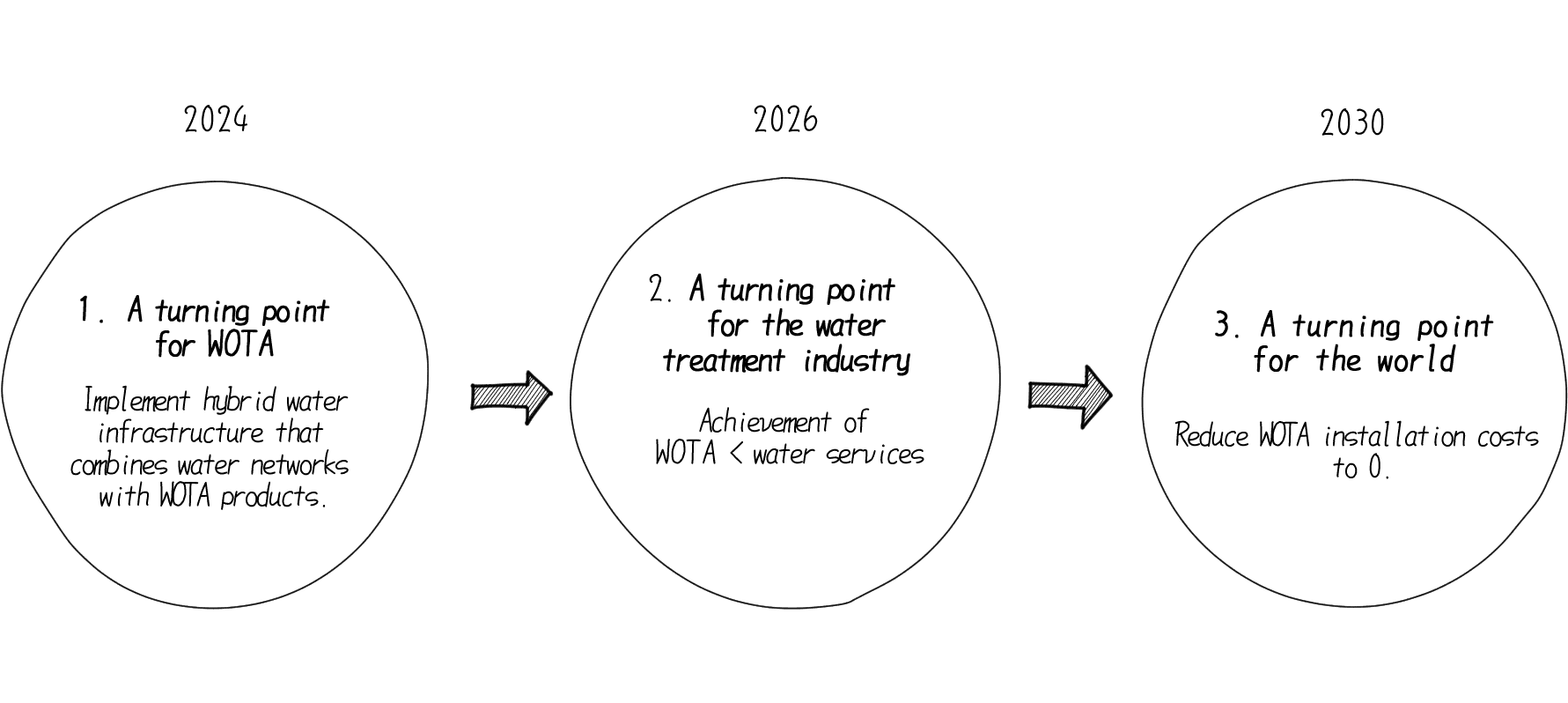
2024: Implement hybrid water infrastructure that combines water networks with WOTA products.
2026: Drop WOTA operating costs below water utility rates to demonstrate feasibility of replacing water infrastructure with WOTA products.
2030: Reduce WOTA initial installation costs to 0.