
Master Plan Part2, Yosuke Maeda, CEO of WOTA Corp, October 24, 2026
In July 2018, we took three prototypes to western Japan, where record-breaking rainfall had caused widespread flooding and landslides. We operated them around the clock, but managed to provide water for daily use at only one evacuation shelter.
Since then, we have worked to industrialize water treatment through the development and mass production of decentralized water regeneration systems.
Water infrastructure has always been built as construction projects, engineered one site at a time. Industrializing it means turning it into a manufactured product.
Regenerate water where it is used. Drive down costs through mass production. Build the optimal mix of centralized and decentralized water infrastructure.
The plan I laid out in Part 1 hasn’t changed.
We are beginning to see the results.
During the 2024 Noto Peninsula Earthquake in Japan, water regeneration systems were deployed to 89% of evacuation shelters experiencing prolonged water outages. Following the July 28, 2026 Kumamoto Earthquake, we also supplied water for daily use to evacuation shelters, hospitals, and care facilities across the affected area.
By reducing the volume of water that needs to be transported to roughly one-fiftieth of conventional levels, we have begun to make showers and handwashing—services that were previously extremely difficult to provide at scale—a practical part of everyday life, even in a disaster.
We are also making progress with everyday water infrastructure. In some regions, decentralized systems are already more economically rational than extending or replacing conventional water networks. Field demonstrations are advancing.
But this is nowhere near enough to solve the world’s water problems.
Part 1 continues. In Part 2, I want to lay out what I believe we need to do next to bring these technologies to the world.
Consider the world in 2050.
In regions experiencing rapid population growth, water infrastructure cannot keep up with demand. In regions where populations are declining, the cost of replacing pipelines and treatment facilities does not fall proportionally with the number of users. The cost per person rises.
In growing regions, infrastructure struggles to keep pace. In shrinking regions, it becomes increasingly difficult to sustain.
The global water crisis is no longer just about water scarcity or pollution. It is also about the economic sustainability of the infrastructure itself.
What we need is water infrastructure that can adapt in scale and location as populations and demand change.
Redesign Water Infrastructure Through Circularity, Autonomy, and Decentralization
What humanity needs is not water transported over long distances. What we need is safe, convenient access to water.
If water can be regenerated where it is used, water use no longer has to depend on long-distance transport.
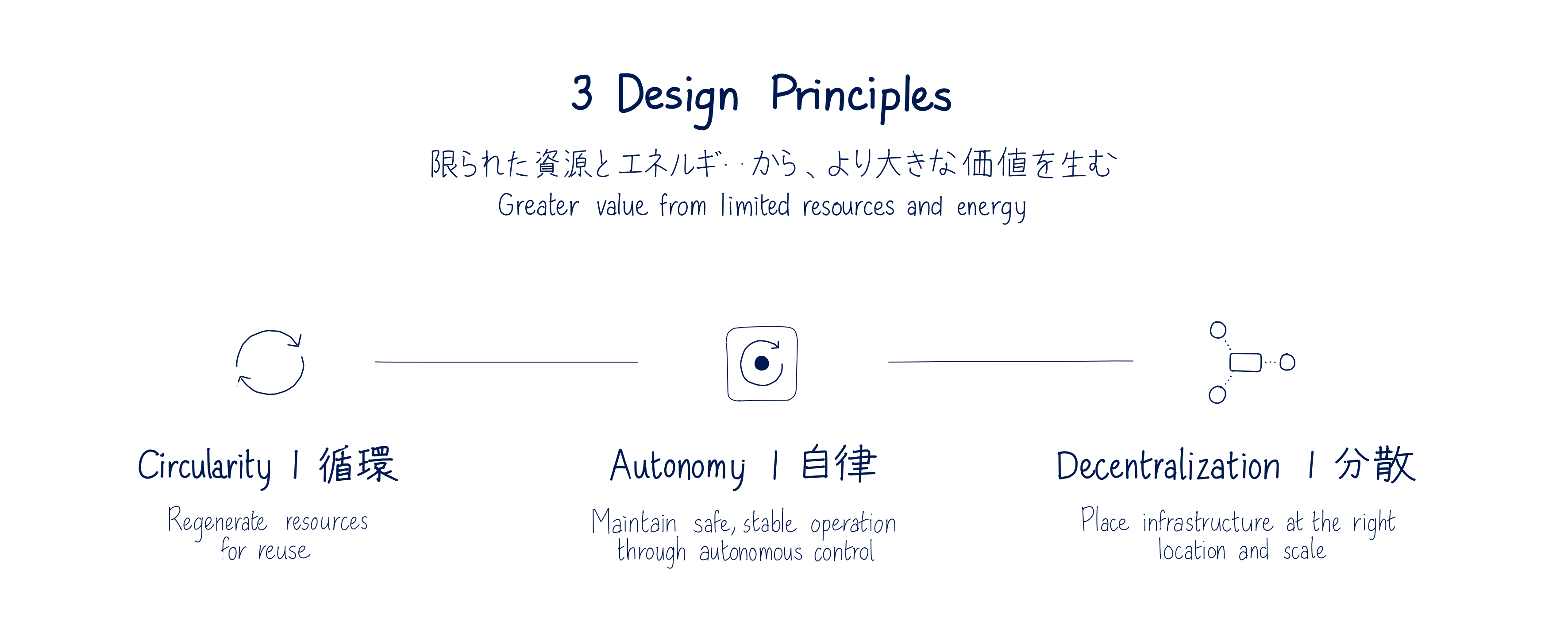
WOTA’s principles are circularity, autonomy, and decentralization.
Circularity means returning resources to a usable state so they can be used again, minimizing the need for new inputs and the loss of recoverable value.
Autonomy means monitoring, decision-making, and control that maintain safe and stable operation without excessive dependence on continuous human intervention or external supplies.
Decentralization means placing infrastructure where it makes the most sense, considering where resources are generated and used, transport distances, and treatment scale. It also means taking advantage of the economies of scale of centralized infrastructure wherever appropriate.
We are not trying to maximize any one of these principles in isolation.
Together, these principles allow us to create greater value with fewer resources and less energy.
WOTA’s water regeneration systems can regenerate up to 98% of the water supplied to them.
In some low-density regions, replacing conventional water networks can cost hundreds of thousands of dollars per household.
Small-scale decentralized water regeneration systems, by contrast, have the potential to bring total lifecycle costs—including equipment, installation, operation, maintenance, and replacement—down to tens of thousands of dollars per household. There are already regions where decentralized systems make more economic sense than centralized infrastructure.
Of course, decentralization is not always the better answer.
Where conventional water networks make economic sense, we should make full use of them. Replacing water infrastructure does not mean eliminating centralized water systems. It means finding the best mix of centralized and decentralized infrastructure for each region.
That choice is already possible in some places.
Next, we need to make it possible under a much wider range of conditions around the world.
Make Everyday Water Use Possible, Even During Disasters
A person needs only a few liters of drinking water a day. But bathing, laundry, and other daily activities require dozens of times more.
Continuously transporting that much water into disaster-stricken areas is extremely difficult.
Water regeneration can reduce the volume of water that needs to be transported to roughly one-fiftieth of conventional levels.
Our goal is to build a system in which everyone can access water for daily needs, even during disasters.
Imagine the morning after a major earthquake.
Major evacuation shelters already have water regeneration systems pre-positioned. Within the day, they become places where people can safely use water for essential daily activities.
Information from shelters is collected and consolidated. Additional equipment is brought in from across the country wherever it is needed. Trained personnel arrive to operate it, and public funding covers the necessary costs.
Plans for water demand, equipment deployment, operations, and support from other regions are already part of local disaster preparedness.
And when the next disaster strikes, a region that once received help becomes a region that helps others.
During the Noto Peninsula and Kumamoto earthquakes, we demonstrated that water for daily use can be supplied across large disaster areas, and that local governments nationwide can pool equipment and personnel to support affected communities.
We are now turning that proven approach into permanent, reliable public infrastructure. The underlying principle can be applied across national borders.
But we are not yet equipped to handle a disaster that simultaneously affects multiple major metropolitan areas. Our current equipment, supply networks, and operational capacity are not sufficient.
We need to expand not only the technology, but society’s capacity to deliver it—transforming access to showers and handwashing during disasters from exceptional assistance available in only a few locations into essential infrastructure that can be reliably deployed nationwide.
Industrialize Water Regeneration and Standardize the Deployment of Decentralized Water Infrastructure
To solve the world’s water problems, we need to manufacture water regeneration systems at a radically greater scale.
That means designing for mass production, standardizing components, and improving manufacturing processes so that quality keeps improving while costs keep falling.
The industrialization of water treatment, which I laid out in Part 1, remains central to the plan.
But mass-producing equipment alone will not transform the world’s water infrastructure.
Water quality assurance, system design, installation, operation, and maintenance cannot be reinvented for every product and every location. If they are, manufacturing capacity will grow faster than our ability to deploy it.
Our next step is to make decentralized water infrastructure as scalable to deploy as it is to manufacture.
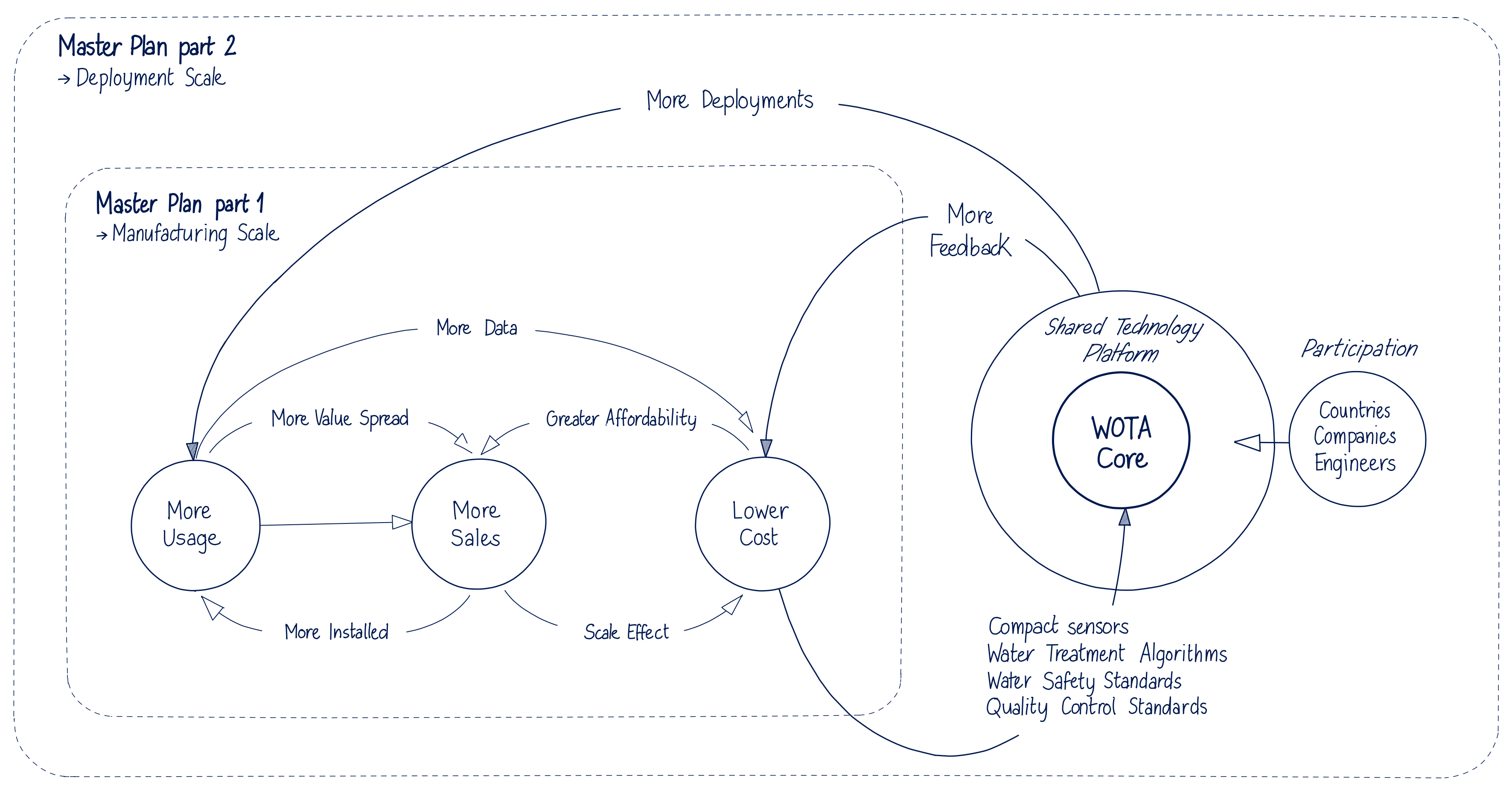
In developing our water regeneration systems, we have already reduced the cost of compact sensors for monitoring water quality and other parameters to approximately one-tenth to one-hundredth of conventional levels.
Now we want to take innovations like these beyond individual products and turn them into a shared technology platform that can be used around the world.
At the center of this effort is WOTA Core.
It integrates water treatment, sensing, and autonomous control to deliver safe, reliable water use. It also provides a common framework for standardized installation, operation, and quality management.
Data and experience from the field feed directly into better product designs, installation methods, quality, and operations.
We will expand our own manufacturing capacity while enabling manufacturers around the world to use WOTA Core to build water regeneration systems suited to their local conditions. Other companies and organizations will be able to install and operate those systems.
As production volumes increase, manufacturing costs fall.
As deployments increase, technology and standards improve, reducing the cost and time required for the next deployment.
And as more companies and engineers participate, both manufacturing capacity and deployment capacity expand.
We will combine the economies of scale of manufacturing with the economies of scale of deployment.
Beyond mass-producing our own systems, we will provide the common foundation that enables companies and engineers around the world to manufacture, install, operate, and continuously improve water regeneration systems—accelerating progress toward solving the global water crisis.
Make Resource Regeneration the More Economical Choice
Regenerating water and returning organic resources to the soil have something fundamental in common.
Both are about transforming resources into the right state, in the right place, for their next use.
Humanity has developed excellent technologies for safely treating materials.
Combustion has made it possible to reduce waste volumes hygienically while recovering heat. Biological wastewater treatment has protected water quality and public health.
But in the process, we also lose carbon and nitrogen that could have been valuable for other uses.
The question is how much of that value we can preserve while maintaining the benefits of existing treatment technologies.
What should we break down? What should we preserve? And where should those resources go next?
The answers determine how much energy we need, how far resources must travel, and how much value we ultimately recover.
I believe we can put several times more nutrients to productive use while reducing the external energy required for treatment to one-tenth or less of conventional levels.
In Japan, only about 10–15% of the solids generated by municipal wastewater treatment are used as fertilizer, even though they contain organic matter and valuable nutrients. Meanwhile, Japan imports most of the raw materials for the fertilizer its agriculture depends on.
Imagine turning organic resources recovered from wastewater treatment, along with livestock manure, into materials that are genuinely valuable for soil and crops—and putting them to use on nearby farmland.
If we can make this economically viable while meeting requirements for safety, quality, energy use, and transportation, materials that once cost money to dispose of can become valuable resources supporting local agriculture.
We will apply the technologies and deployment capabilities developed through water regeneration to organic resource regeneration.
Water. Energy. Food. Air. Materials.
In nature, these are deeply interconnected. Yet human infrastructure, industries, and institutions have largely treated them as separate systems.
I call this broader vision WEFAM—Water, Energy, Food, Air, and Materials.
The idea is to move beyond optimizing each resource in isolation and rethink how resources are transformed, used, and regenerated as part of an interconnected whole.
UN 3.0
The world already has much of the technology, capital, and talent needed to solve humanity’s biggest problems.
But having those capabilities somewhere in the world is not the same as making them work where they are needed.
Water is a perfect example.
Technology companies, infrastructure operators, governments, financial institutions, and local communities all have capabilities that matter. The challenge is bringing those capabilities together to actually solve the problem.
WOTA’s goal is not to concentrate all those capabilities within one company.
It is to enable people and organizations around the world to plan, act, share results, and improve together.
The cooperation we have seen among local governments during disasters is an early example of what this could look like.
If this approach can work globally for a single challenge—water—it may also offer a model for addressing other resource challenges, and potentially broader challenges facing humanity.
I don’t envision replacing nations or international institutions. I envision a community in which people and organizations bring their capabilities together across borders to solve shared problems.
Such a community could give rise to a new form of publicness—one that complements existing institutions.
I call one possible form of that future UN 3.0.
The milestones I set out in Part 1 remain goals we intend to achieve.
One of those goals is to make small-scale decentralized water regeneration systems accessible without requiring a large upfront investment from the user. That means making the economics work across equipment, installation, operation, maintenance, replacement, and financing.
Building on Part 1, Master Plan Part 2 is:
- 1.Make access to water for daily use during disasters an essential part of public infrastructure, supported by preparedness and cooperation across regions.
- 2.Continue industrializing water regeneration, while enabling systems to be manufactured, deployed, and improved by companies around the world.
- 3.Extend what we have learned from water to organic resources, making resource regeneration the more economical choice.
By 2050, we aim to make safe, convenient water use possible for everyone, in regions with growing populations and those with declining populations alike.
To achieve this, we will make water regeneration an economically viable option worldwide.
And from water, we will expand our efforts to resource regeneration—and toward a new form of publicness that brings people and organizations together across borders.